A Total Beginners Guide To Recognising The Historical Era of European Ships
Fixing the skillset you didn't know you needed

Ann Radcliffe, noted Gothic author, characterised terror as a state of fearful anticipation, and horror as an awful realisation. She says that terror “expands the soul and awakens the faculties to a high degree of life”, whilst horror, in contrast, “freezes and nearly annihilates them” with its unambiguous displays of atrocity.
True horror is therefore a rare occurrence in our comfortable modern lives, reserved for such occurrences as the late night knock on the door from the policeman, the somber doctor’s note summoning you to discuss test results, or the recent lived experience of Prince Andrew’s PR team.
This article today is motivated by my own brush with horror. Brace yourself reader, even the written report of this occurrence may be difficult.
A few days ago I sent a meme to a friend of mine (as those who know me will admit I am wont to do). It featured the below screenshot, and the phrase “imagine living in 1805 and Boccherini drops this absolute banger”.
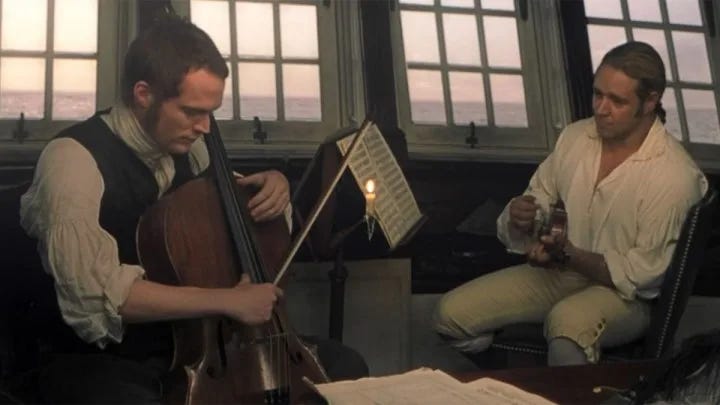
A feeling I think we can all understand would best be described as euphoric.
In response, my friend …
… suggested that this screenshot was from the new Game of Thrones show.
Take a moment. Compose yourself.
At first, of course, I assumed they were joking. Certainly a joke in ill taste, but surely a joke for all of that. No one could look at the distinctive windows at the back of a beautiful early 19th century frigate and mistake it for a 15th / 16th century carrick / cog / dromond, right? You might as well mistake a human child for frog spawn!
It’s almost as if people exist who aren’t Age of Sail history dorks!
Still, as with most things in life, I try to live by the teaching of the great prophet, Randall Munroe.

And who wants to miss out on the fun of talking about sailing ships! But how to help my unfortunate friend learn to tell the difference?
For a little while I have been making excuses to invent projects to practice with AI tools, with the hope of perhaps retaining employment come the robot apocalypse. And one tool I have been meaning to practice with is Claude Cowork, much vaunted future obsoleter of white collar work.
Given my recent history of writing about science, you may therefore think that this long build up about sailing ships was in fact an elaborate double bluff, and this article is now about to transition into being a piece on the efficiency or otherwise of Claude for research projects and report writing.
And well you might think that. That would make sense. There is quite a lot I can now say about Claude’s strengths and weaknesses, based on this project.
But alas for you, it was a triple bluff! This actually IS about sailing ships. I might write an article another day about AI tools and what I have learned and what cuts through the hype (or get Claude to do it, who knows, I’m a path of least resistance guy).
But not today!
Today I present to you, the Andrew and Claude collaboration that is, a visual guide to the ages of European sailing ships. I invite you to take a moment and reflect on the raw fucking human spirit that took bits of wood and cloth and turned them into machines for exploring the world (and also, regularly, drowning to death).
Age 1: Medieval Oar and Sail (c.1000–1400)
Key features
1. One mast, one sail: Every northern European ship of this era has a single mast carrying one large rectangular sail. More than one mast means post-1400. And really when you are sailing on something this small, one is all you need.
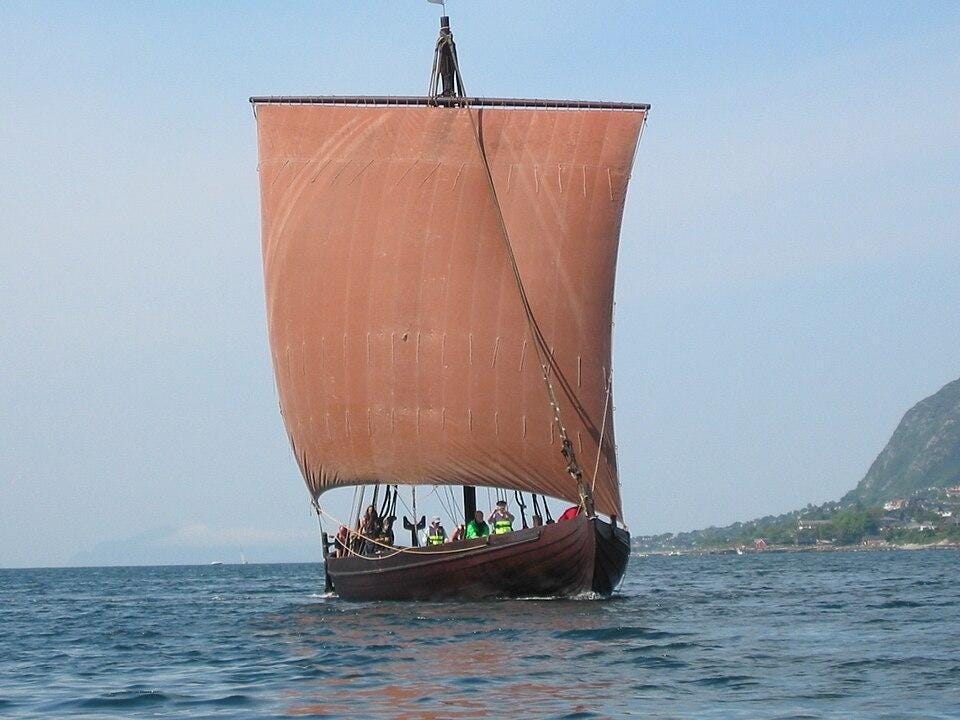
Skuldelev Ships (c.1030–1070) — range of Viking vessel types; Viking Ship Museum, Roskilde. Source: Wikipedia
2. Overlapping planks: The hull is built from horizontal planks that overlap like clapboard siding, creating a stepped, ribbed-for-extra-pleasure texture.
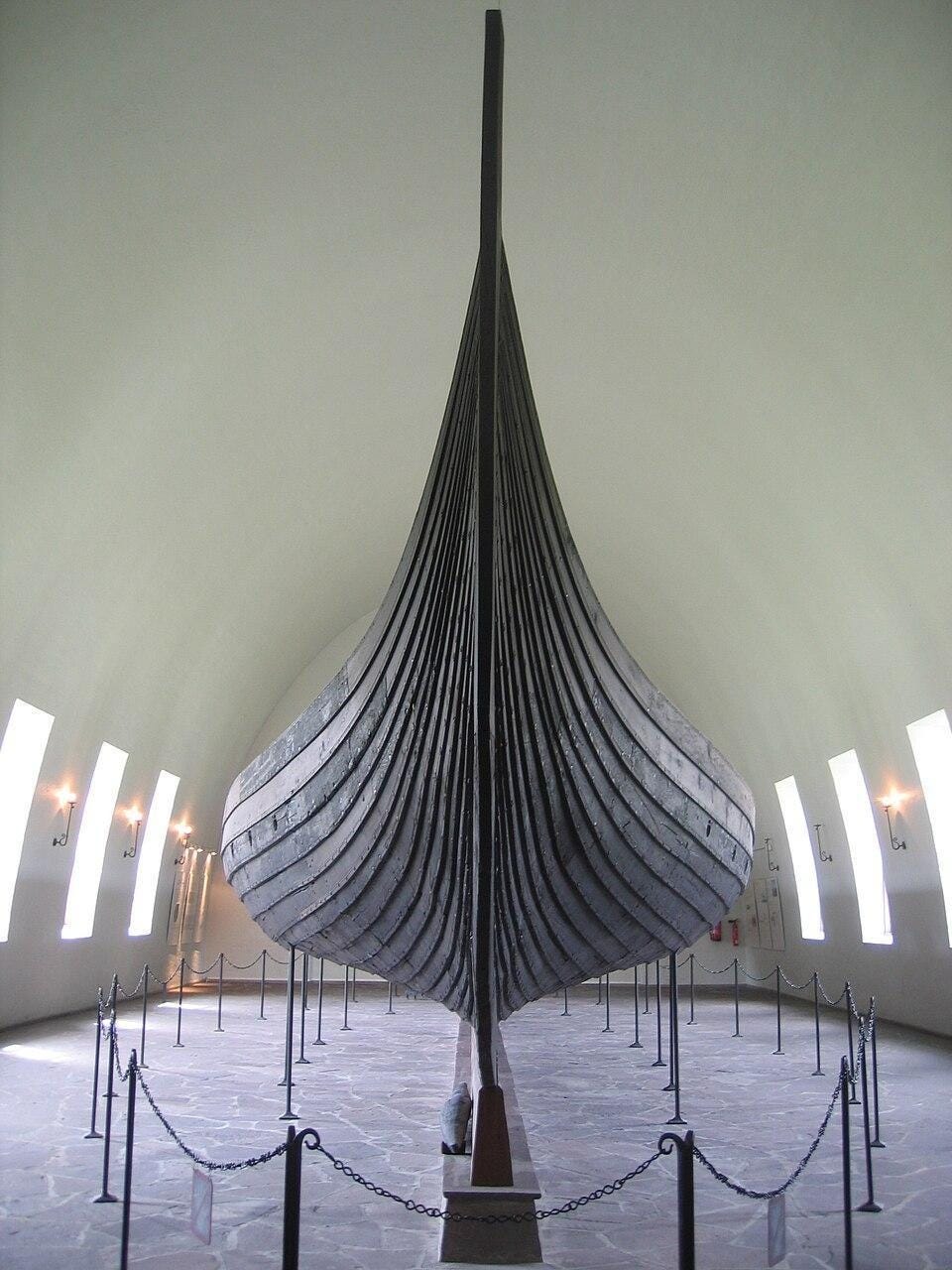
Gokstad Ship (c.890) — classic Viking longship; Museum of the Viking Age, Oslo
Source: Wikipedia
3. Two distinct shapes: Viking longships are long, narrow, and sit low in the water with curved ends and rows of oar holes along the sides. Cogs are the opposite — short, fat, high-walled cargo ships with flat bottoms and small wooden tower platforms at front and back.
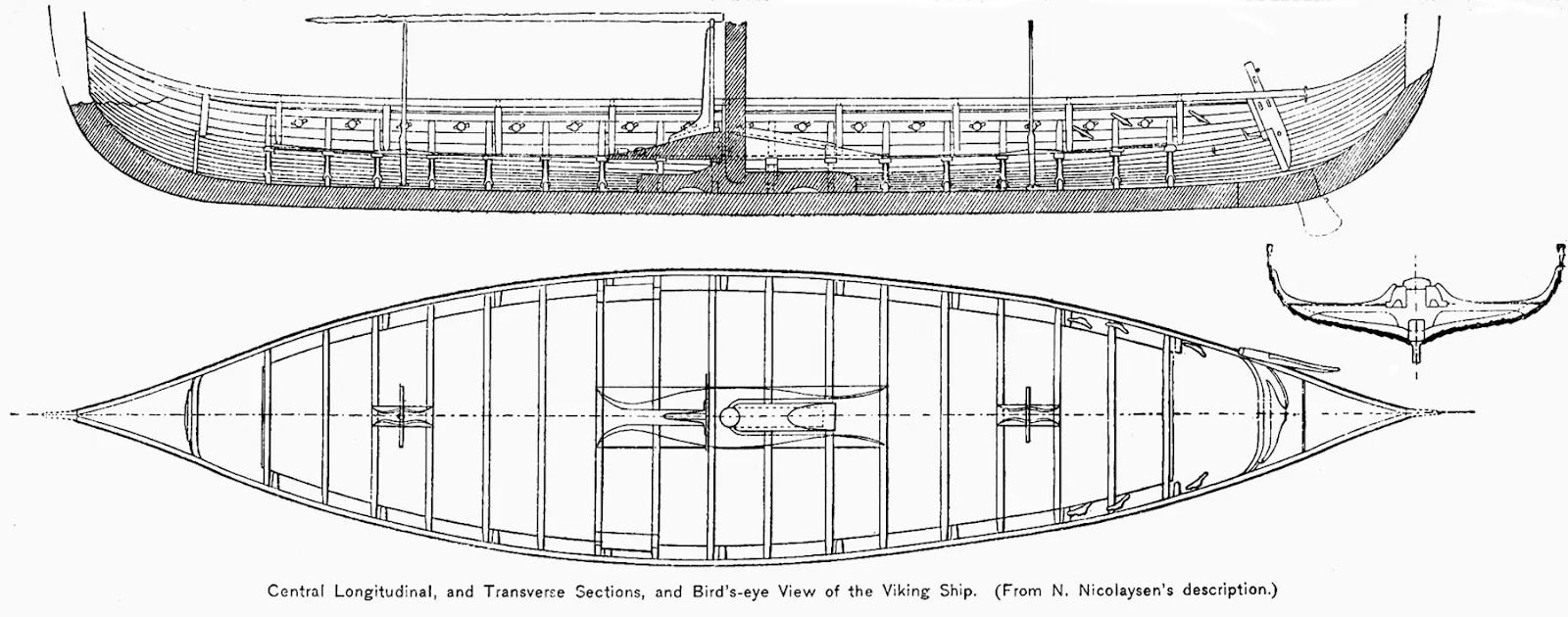
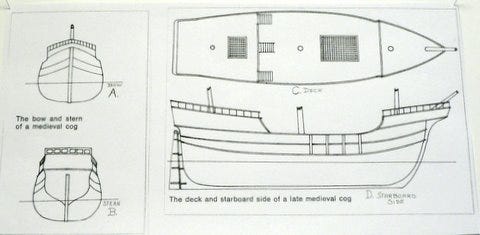
Top: Longship — long, narrow, low freeboard, curved ends. Bottom: Cog — short, high-sided, flat bottom, castles fore and aft.
4. Rudder position: Longships have a steering oar strapped to the right side near the back. Cogs have a rudder mounted centrally at the very back — an innovation that became standard on all later ships. Also enjoy the great tapestry work. Not enough tapestry these days.
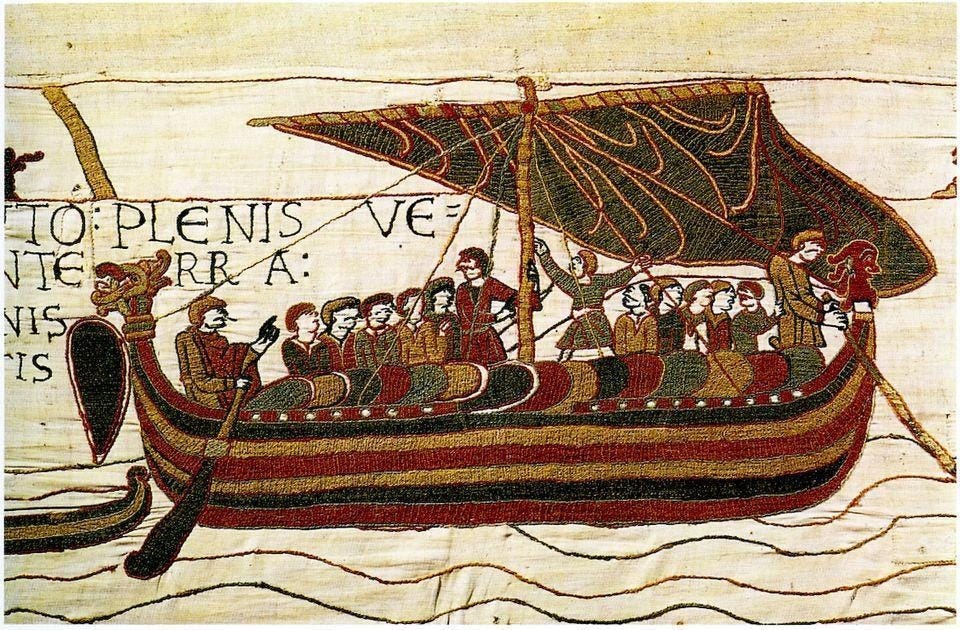
Bayeux Tapestry (c.1070) — Norman longships with side-mounted steering oars and single masts. Source: Bayeux Museum
Why ships looked this way
A single rectangular sail worked well enough for sailing downwind across the North Sea and Baltic - at this point in time, folks just waited for favourable winds. The overlapping plank technique produced strong, flexible hulls suited to rough northern seas. Longships were built for speed and shallow water. Given a draw of less than a metre, they could sail up rivers - perfect for when you needed to murder monks who were inconveniently on land! Cogs were built for cargo capacity on a minimal crew, and their flat bottoms let them sit upright on tidal beaches. The tower platforms started as fighting positions giving archers a height advantage during boarding, which was how medieval naval battles were fought.
Age 2: Carracks and Caravels — Age of Exploration (c.1400–1550)
Key features
1. Three masts: The jump from one mast to three is the single clearest sign you’ve crossed into this era and you are looking at a carrack. The front and main masts carry rectangular sails, whilst the rear mast carries a triangular sail.
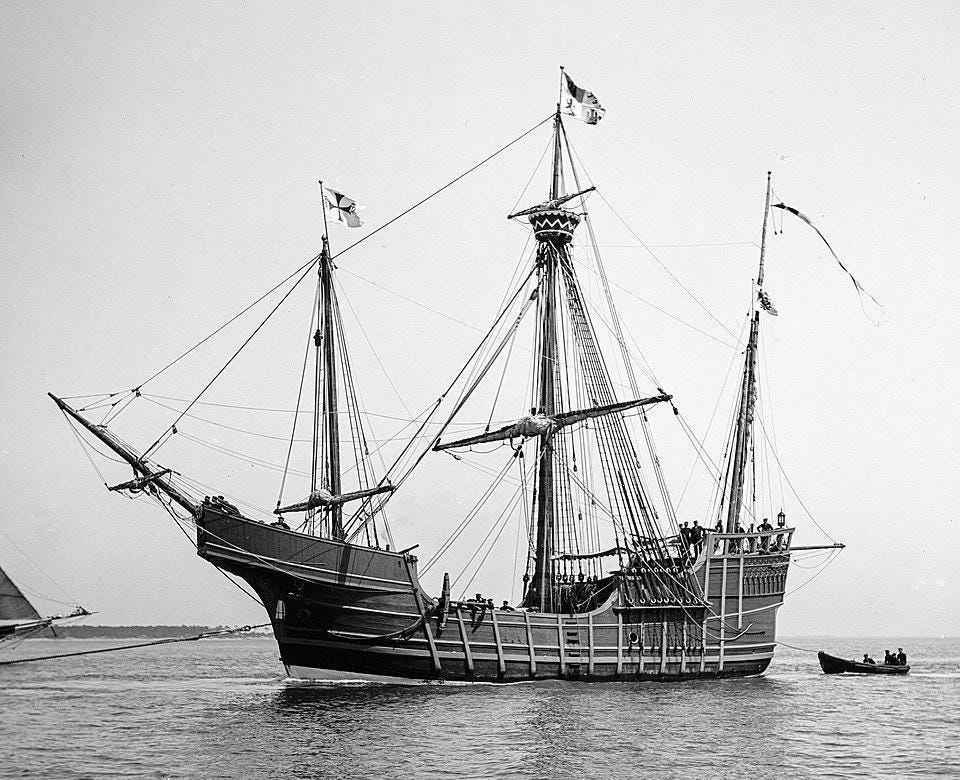
Santa María replica — showing the much more advanced sail setup compared to the previous age. Source: Wikipedia
2. High platforms at both ends: a carrack has towering multi-storey structures at front and back with a lower open deck between them, giving a U-shaped side profile. No other era looks like this. Clearly visible in the replica above and engraving below.
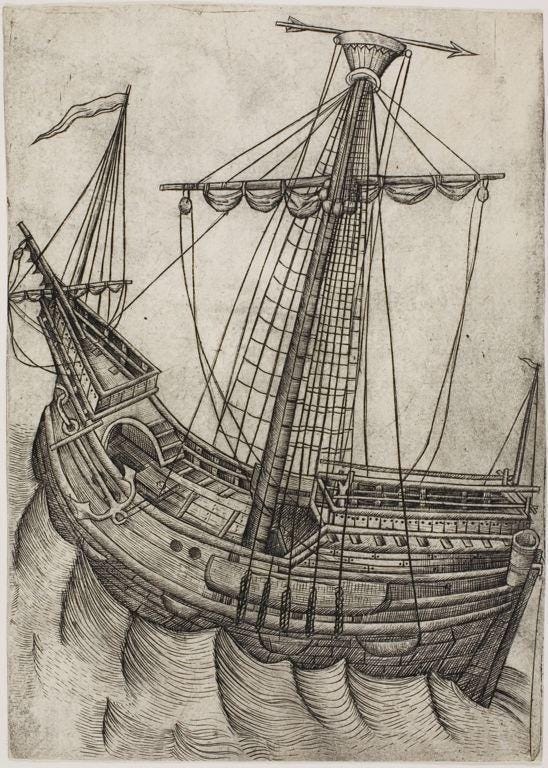
Kraeck engraving by Master W.A. (c.1470–1490) — the most famous illustration of an early carrack. Source: Wikipedia
3. Smooth hull: planks are laid edge-to-edge instead of overlapping, producing a smooth surface. This is a pronounced difference compared to the earlier ribbed look.
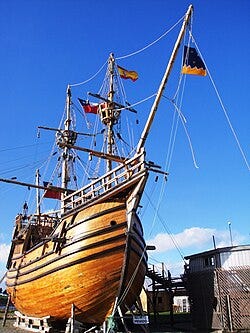
A replica of Nao Victoria — smooth carvel-planked hulls, contrast with overlapping clinker planking above.Source: Wikipedia
4. Caravels vs carracks: Caravels are smaller and slimmer, with triangular sails on all masts and no high front platform.
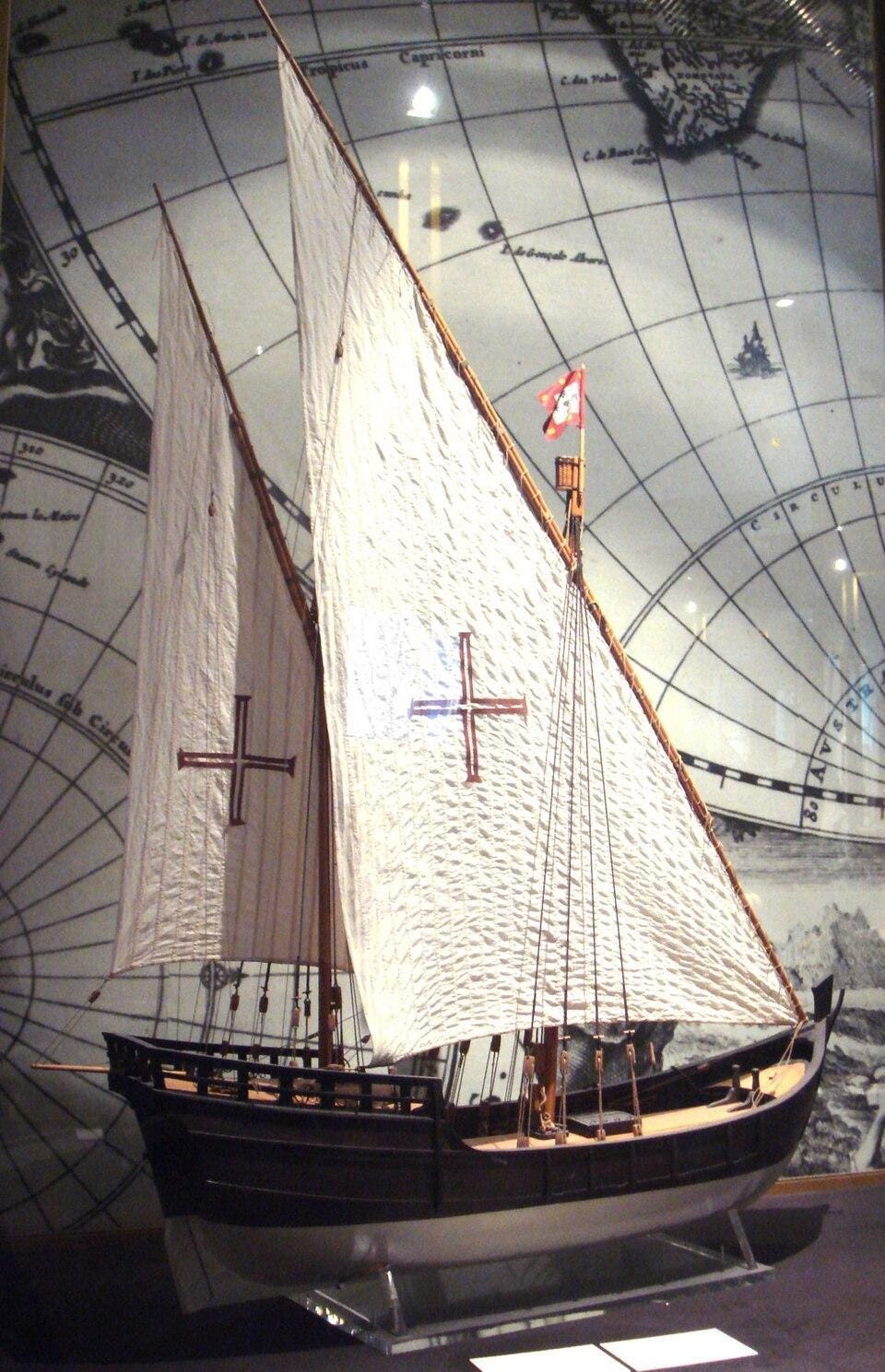
Caravel Boa Esperança replica — classic caravel: triangular sails, low profile, no front platform
Source: Wikipedia
Why ships looked this way
Rectangular sails worked for running before Atlantic trade winds whilst triangular sails let the ship tack against coastal headwinds. Combining both on one ship was a Portuguese and Spanish innovation for ocean voyages demanding versatility. The high platforms served as fighting positions and housed officers’ quarters. The wide, rounded hull provided cargo space for spice-trade voyages lasting over a year. The switch to smooth flush planking allowed bigger hulls and the cutting of holes for cannon.
Age 3: The Galleon Era (c.1550–1700)
Key features
1. Projecting snout at the bow.: A pointed structure extending forward below the front platform, often decorated with a carved figure. No earlier type has this and it has a distinctive look, like a beak or ram.
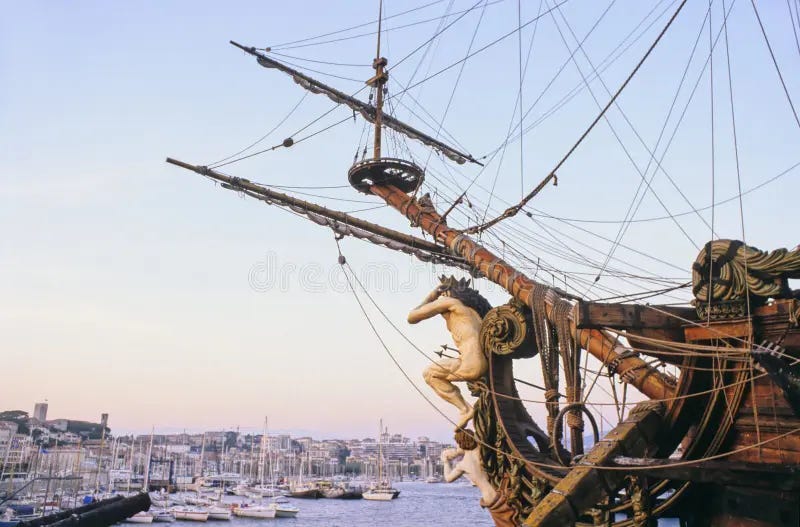
Galleon. Old war ship showing bows full of ornaments and rig on Cannes Bay background. Source: Stock Photo
2. Lopsided profile: the front sits low while the back rises into a multi-deck structure. This upward slope toward the stern is unmistakable compared to the balanced high-low-high of a carrack.
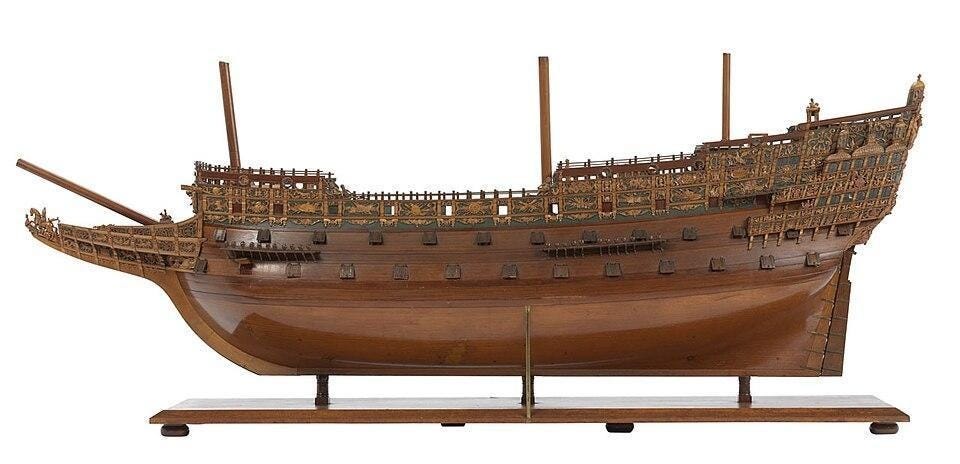
Sovereign of the Seas (1637) — 102 guns, three gun decks. Peak galleon-era ornamentation. Source: Wikipedia
3. Heavily decorated stern: the flat, squared-off back is covered in gilded carvings, coats of arms, windowed galleries on the sides, and a lantern on top.
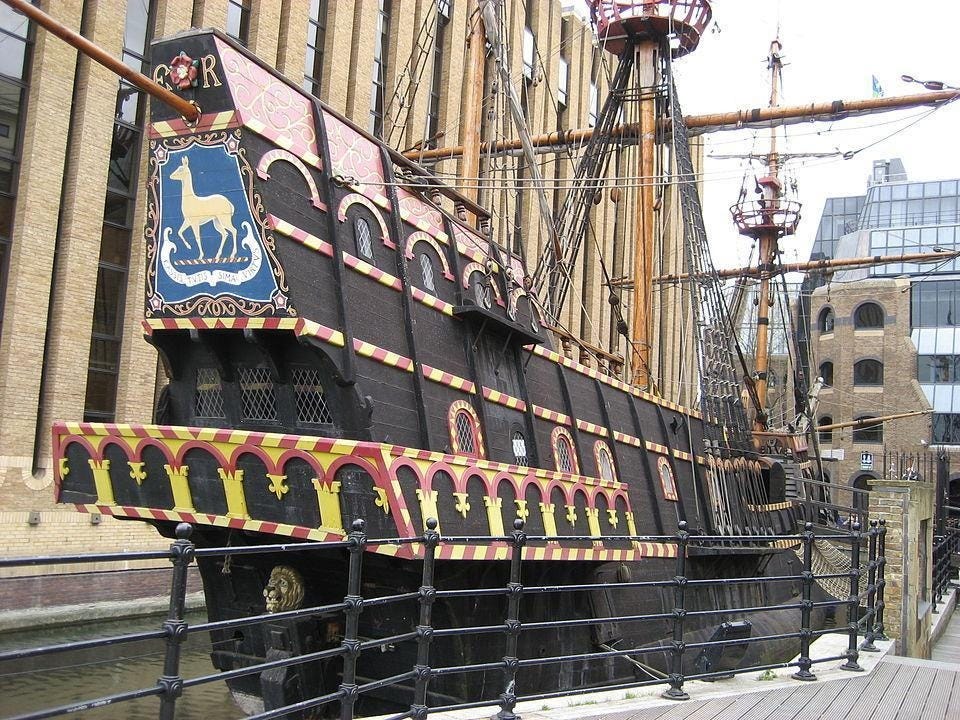
Golden Hinde replica — Drake’s circumnavigation ship (1577–80). Source: Wikipedia
4. Rows of gun ports: one or two rows of rectangular openings with hinged lids run along the hull, reflecting the shift from boarding to cannon warfare. We are in the age of shooting shit at last.
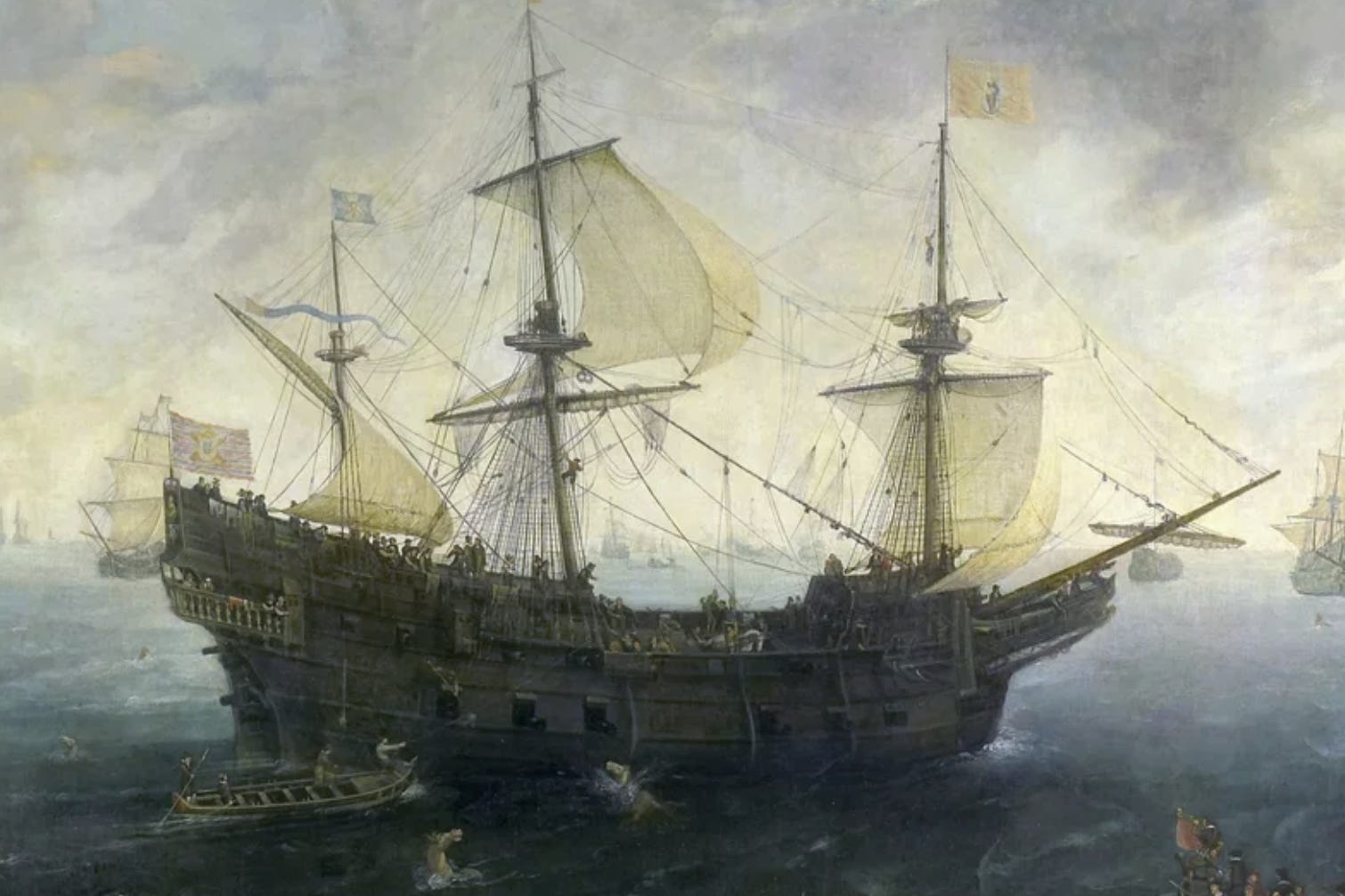
The Spanish Armada of 1588 CE By van Wieringen. Source: World History
5. Slimmer hull: galleons are longer and narrower than carracks, at roughly 3.5–4 times as long as they are wide, compared to about 3 times for a carrack.
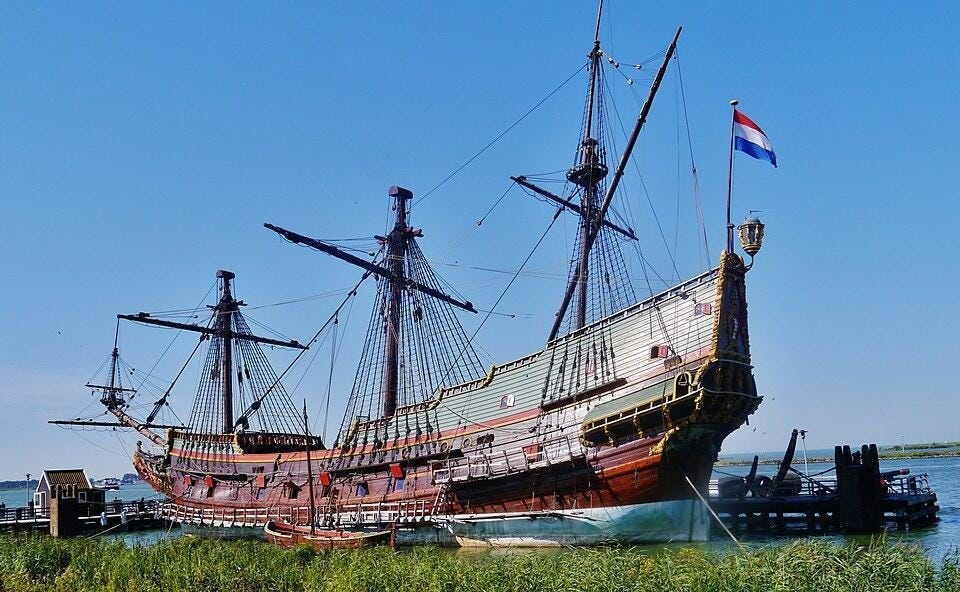
Batavia replica — Dutch VOC merchant variant; practical rather than ornate. Source: Wikipedia
Why ships looked this way
Naval warfare shifted from boarding to broadside cannon fire, which required longer, lower, more stable hulls with gun openings cut into the sides. The high front platform was cut down because it caught the wind and slowed the ship. The English built sleeker, faster designs that outperformed the taller Spanish ships during the 1588 Armada. (Anyone that has recently graced a beach in the south of Spain will know that the days of the English being more sleek than the Spanish are far behind us). Decoration was political: the Sovereign of the Seas (1637) cost £65,586, of which £6,691 was gilding. Observers will note that this approach to gilding as political gesture had generally fallen out of fashion in the west until Trump’s return to the White House.
Age 4: Ship of the Line — Age of Sail Peak (c.1700–1800)
Key features
1. Two or three rows of gun ports: Neat, evenly spaced rows of openings running the full length of the hull. The biggest ships show three rows. This is the single strongest visual cue for the era. Also, they just look fucking gorgeous.
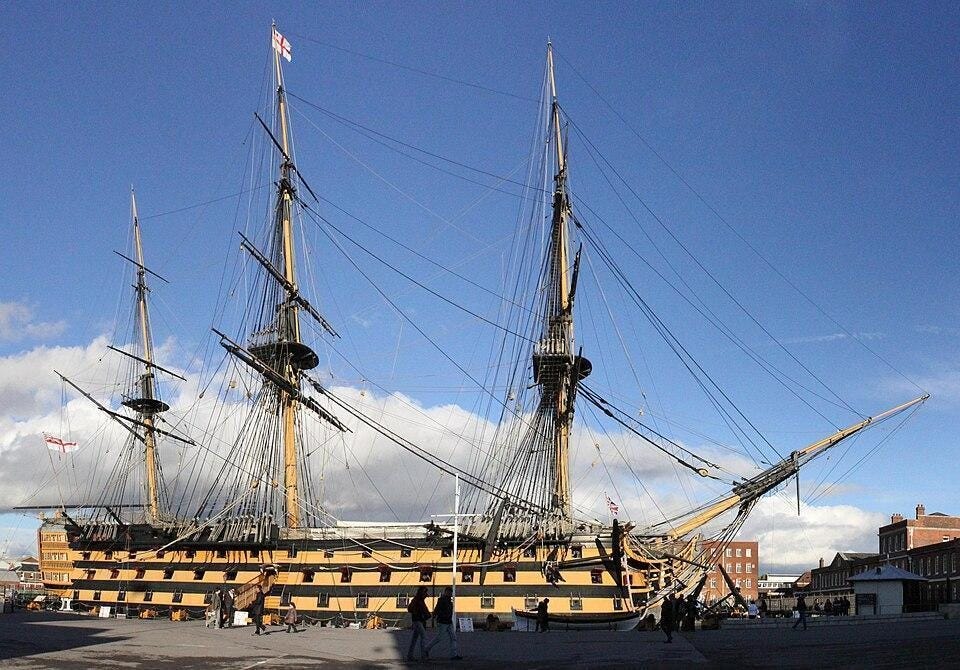
HMS Victory (1765) — the only surviving ship of the line. Three gun decks, Nelson Checker, copper hull. Source: Wikipedia. (Tangent: the volunteers at the HMS Victory museum are some of the best I have ever met. Very worth a visit to Portsmouth)
2. Checkerboard paint: the iconic Nelson Checker scheme — alternating bands of black and pale yellow, with black gun port lids that create a checkerboard when open — was popularised in the British Royal Navy from c.1803. French ships used black with red stripes; Spanish ships red with white stripes. The superior British style choice played a crucial role at Trafalgar, sapping enemy morale.
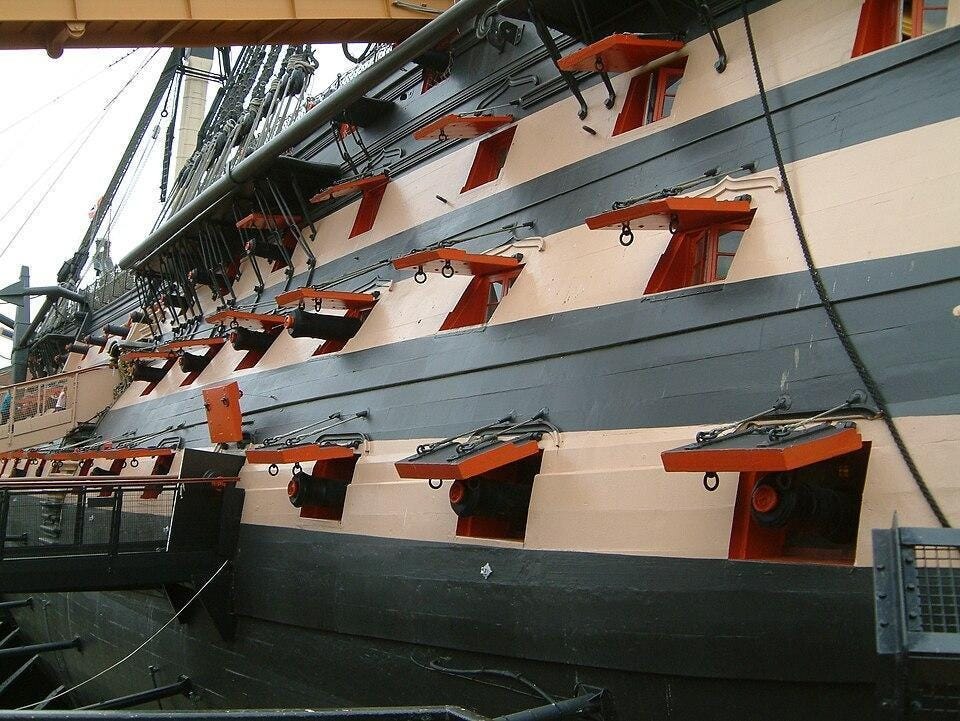
HMS Victory hull detail — Nelson Checker pattern. Black and pale yellow bands. Source: Wikipedia
3. Stern window line: by the mid-18th century, the ornate gilded carvings that once covered a warship’s stern had given way to neat rows of glazed gallery. These provided light and ventilation to the captain’s and officers’ quarters. The number of window rows roughly indicated the ship’s rate - a first-rate like HMS Victory carried three full galleries, while a frigate might show only one. This is also the perfect location to play some cello or violin with your boys.
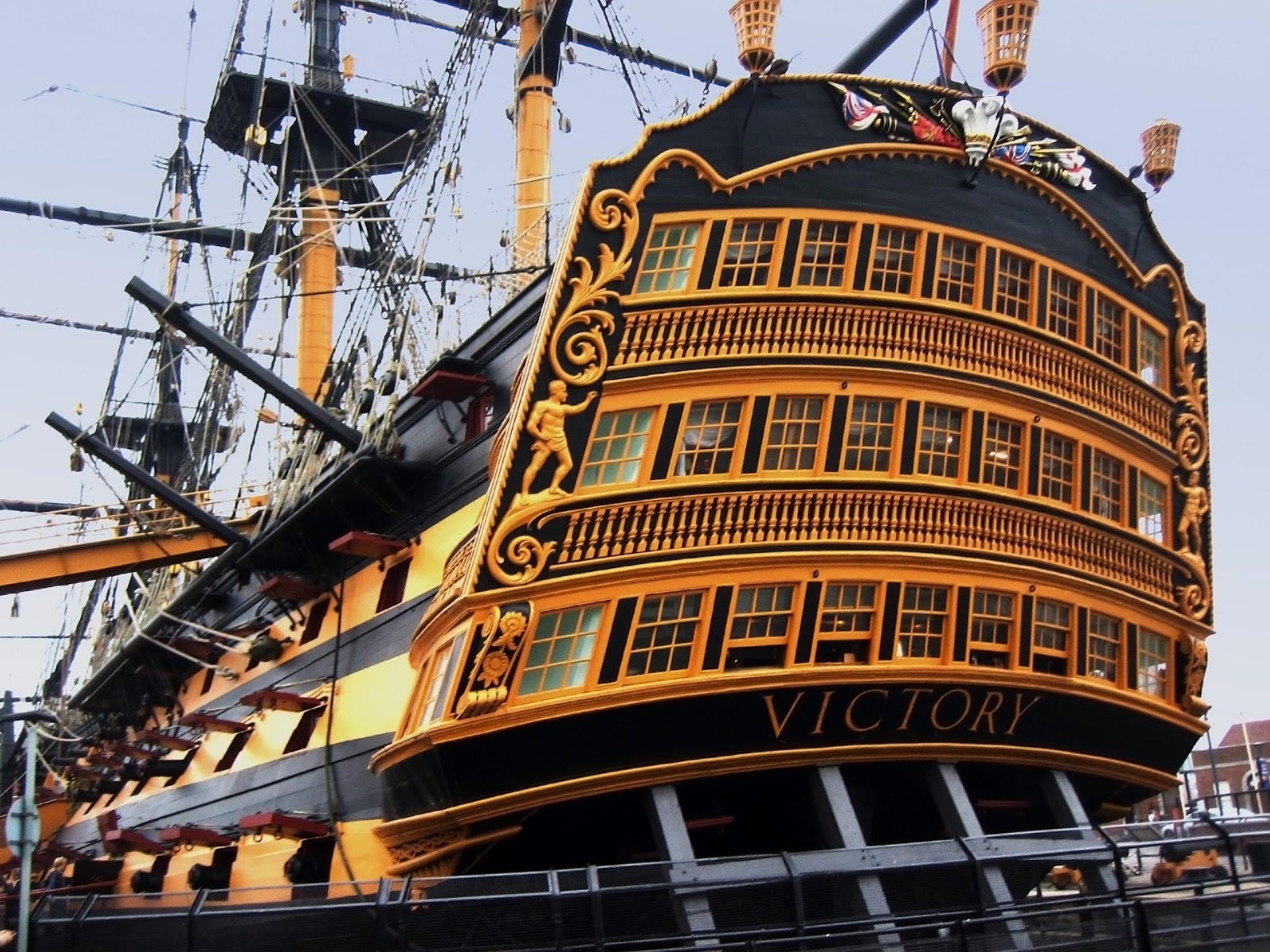
Stern of HMS Victory — window galleries replacing earlier gilded carvings. Source: wikimedia.

4. Pear-shaped cross-section: The hull is widest near the waterline and leans inward as it rises — visible when viewed from front or back. This lowered the centre of gravity for ships carrying 100+ heavy guns, otherwise being knocked over by waves or your own gunfire was a real risk. And you looked like a proper dick if you did that.
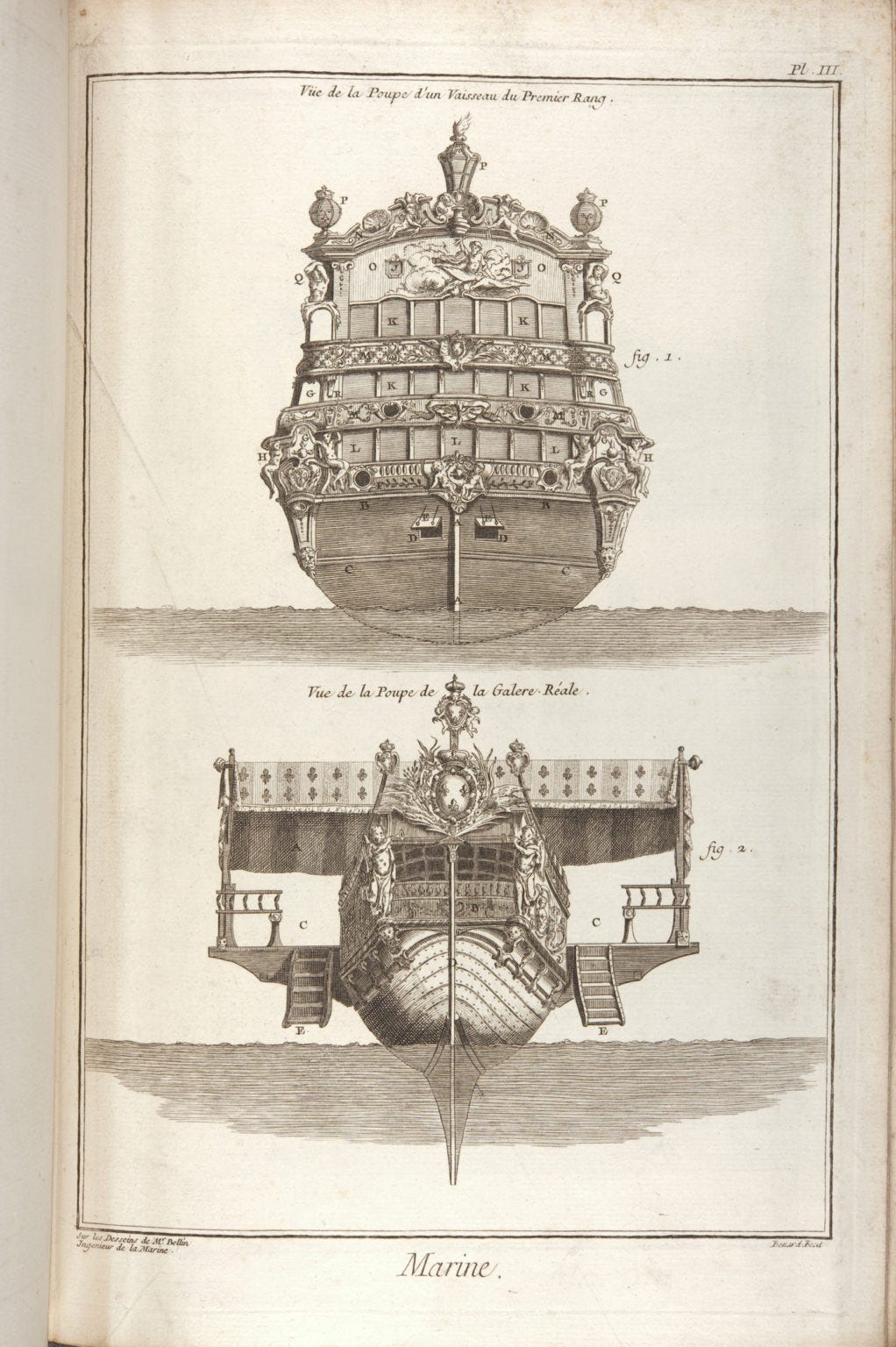
Bow cross-section and hull profile of a ship of the line — plate from the Encyclopédie of Diderot & d’Alembert (1751–1772); Source: St Andrew’s University
5. Forest of rigging: three masts, each built in three stacked sections, carrying up to 37 sails (on HMS Victory) with 42 kilometres of rope. The sheer density of ropes is unlike any other era.
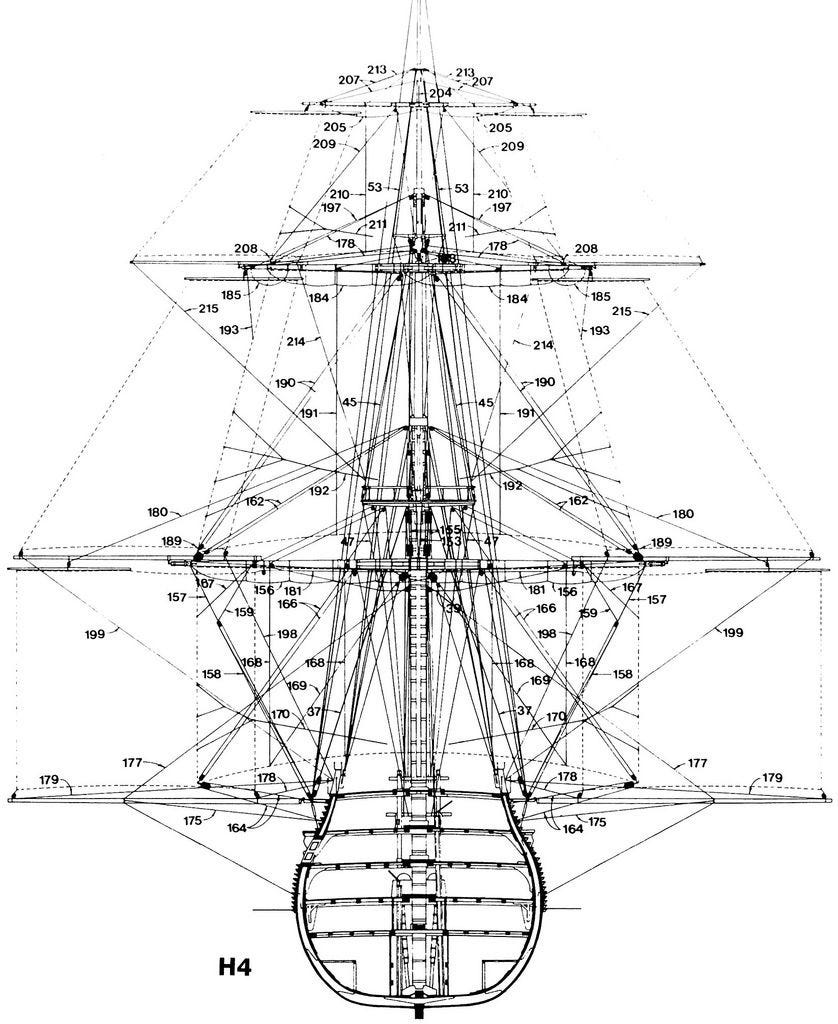
HMS Victory rigging. This is for just a single mast. Source: pinterest
Why ships looked this way
The standard battle tactic was for fleets to form single columns, each ship firing sideways at the enemy. This demanded maximum guns along the ship’s length, a hull strong enough to withstand repeated penetrating hits, and stability for sustained firing. The 74-gun ship became the standard workhorse — big enough to destroy any opponent, cheap enough to build in numbers. Copper sheathing below the waterline (from the 1770s) stopped shipworm from eating the hull, letting coppered ships stay at sea far longer. These ships were dark, were packed with stinking unwashed men, were maintained by brutal discipline and alcohol, and were often staffed by pressed men little better than slaves. But they were also wonders of engineering and looked fucking iconic (from outside of smelling range).
Age 5: When Sails Met Steam and Iron (c.1800–1880)
Key features
1. Sails and a funnel: The defining feature of this time was masts with full sails towering above a hull that also has one or more thin black smokestacks. Earlier ships have only sails; later ships have only funnels. On HMS Warrior (1860), the funnels could telescope down to reduce wind drag under sail (which honestly, is a cool feature. Good work victorian naval engineers).
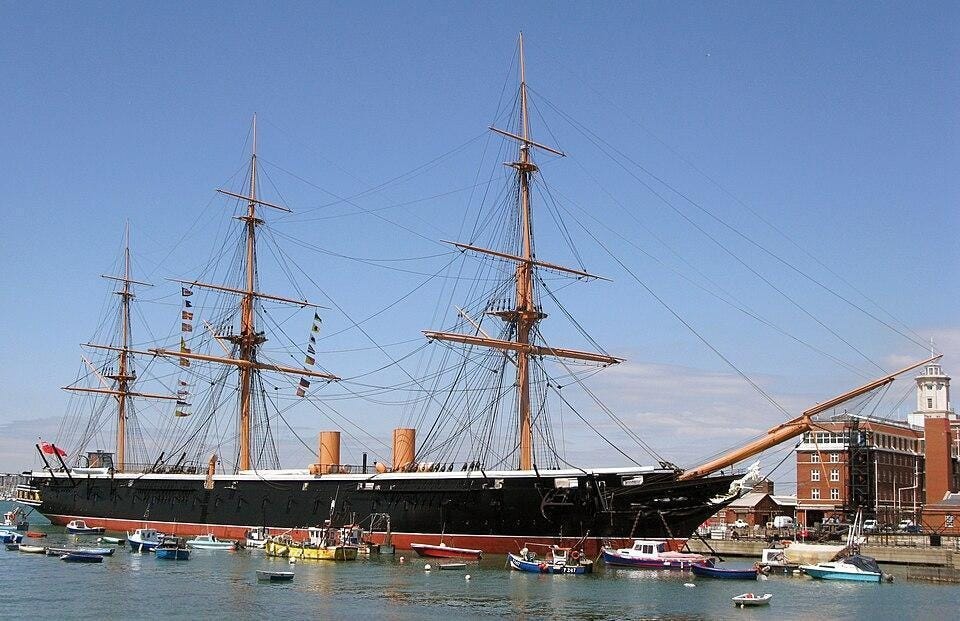
HMS Warrior (1860) — world’s first iron-hulled armoured warship. Full sails with two retractable funnels. Source: Wikipedia
2. Paddle-wheel bulges: Before the 1860s, large semi-circular housings stick out from the sides of the hull at the middle, enclosing paddle wheels. After the screw propeller took over, these bulges disappear as the propeller is hidden underwater.
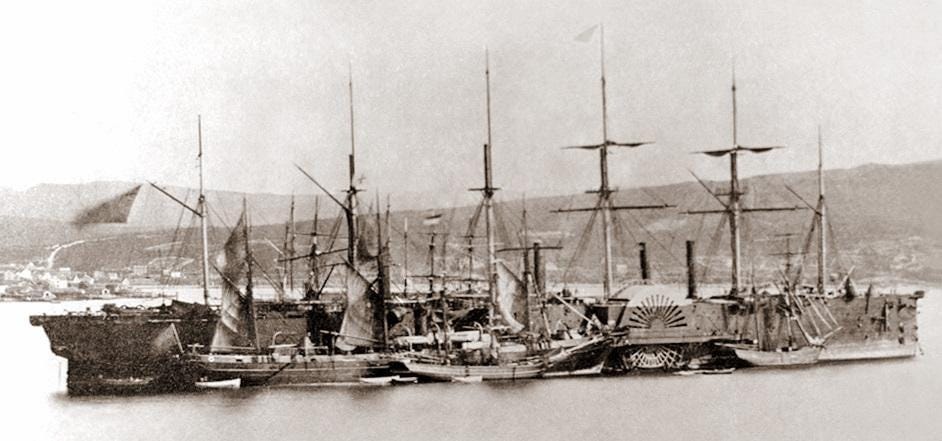
SS Great Eastern (1858) — paddle wheels, propeller, AND sails; 692 feet long, unmatched for over 40 years. Source: Wikipedia
3. Riveted iron plates: Iron-hulled ships have a distinctly industrial look: flat rectangular plates joined by visible rows of rivets - small raised bumps in regular lines across the surface.
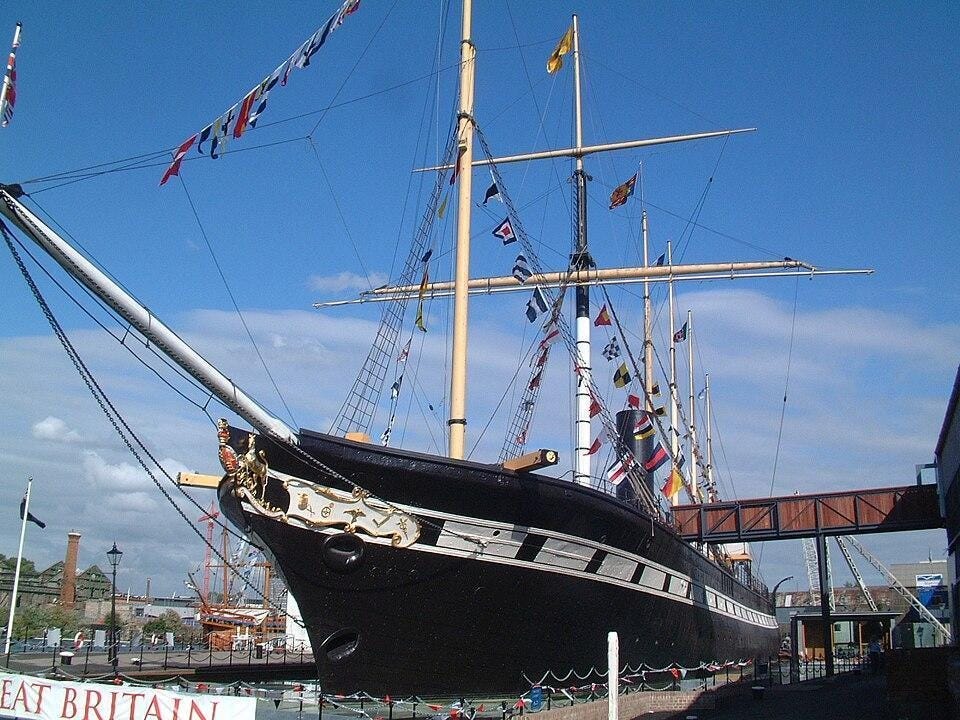
SS Great Britain (1843), the world’s first large iron-hulled screw-propelled ship. Source: Wikipedia
4. Clippers: extreme sail-only, dramatically longer and narrower than older sailing ships (5–8 times as long as they are wide), with a sharp angled bow and enormous amounts of sail. No funnels, no steam. Built for speed, managing up to 400 miles a day. That’s not that impressive in an age of cars and planes, but impresses the hell out of me given they did it with wind alone.
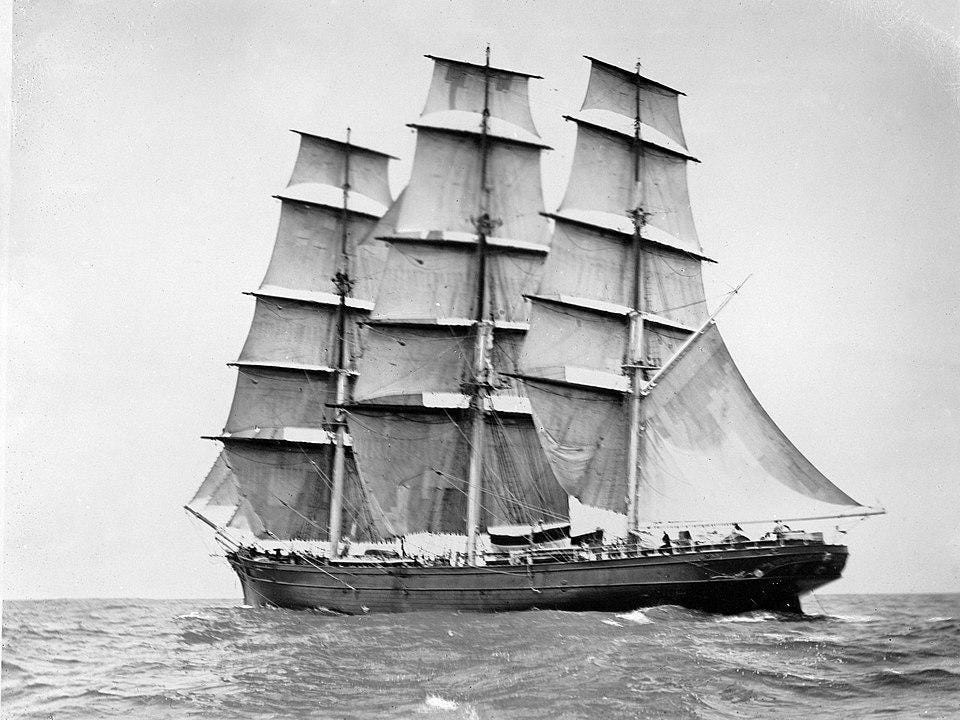
Cutty Sark (1869) — last surviving tea clipper. Pure wind power, no smokestacks. Source: Wikipedia
Why ships looked this way
Early steam engines were unreliable and burned through coal fast, so sails provided backup. These are the Toyota Prius of the naval world. Paddle wheels were vulnerable to damage and blocked the sides where warships needed gun openings — the underwater screw propeller solved both problems. Iron hulls could be built larger than wood, which couldn’t hold together much beyond 300 feet. Clippers existed because the first tea to reach London from China commanded premium prices so speed was profitable. The Suez Canal (1869) killed clippers because steamships could use the shorter route. Ironclads appeared after explosive shells proved devastating against wooden ships at the Battle of Sinop (1853). Being inside a wooden ship that was being struck with explosive shells sounds about the worst thing ever.
Age 6: The Age of Steel (c.1880–1945)
Key features
1. No sails at all: All-steel riveted hulls. Some short bare poles remain for signal flags or radio aerials, but nothing carries canvas.
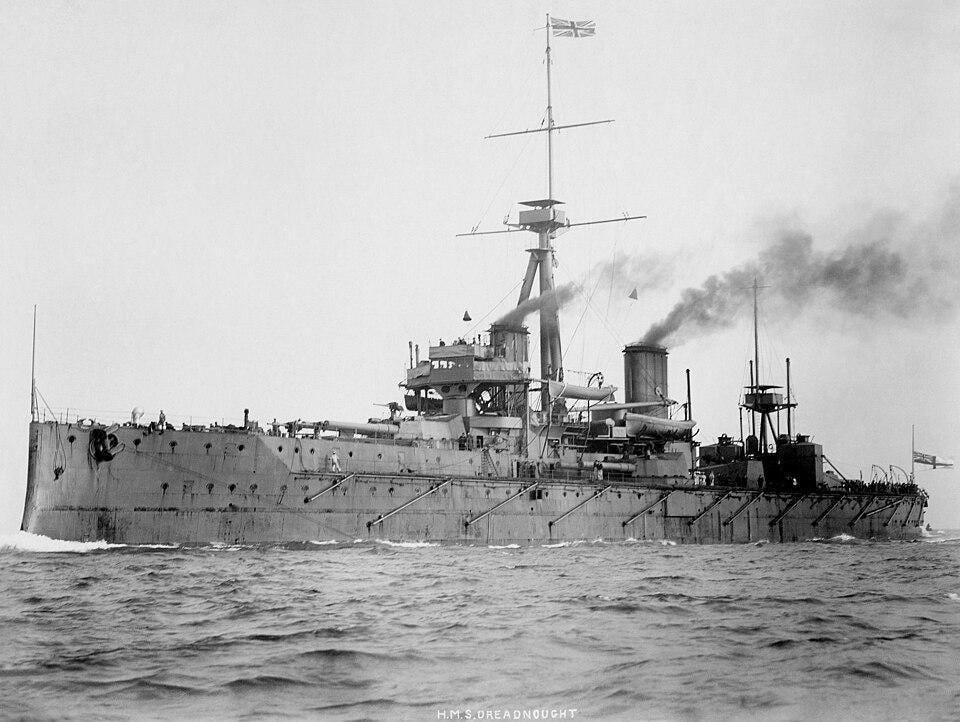
HMS Dreadnought (1906) — five twin gun turrets, two closely spaced funnels. Defined the era.
Source: Wikipedia
2. Funnels define the ship: Ocean liners have two to four tall cylindrical funnels in their shipping line’s colours. Warships typically have one or two. As engine technology improved, funnel count dropped. 1930s liners often had three, whilst after 1935 this dropped to just two or one.
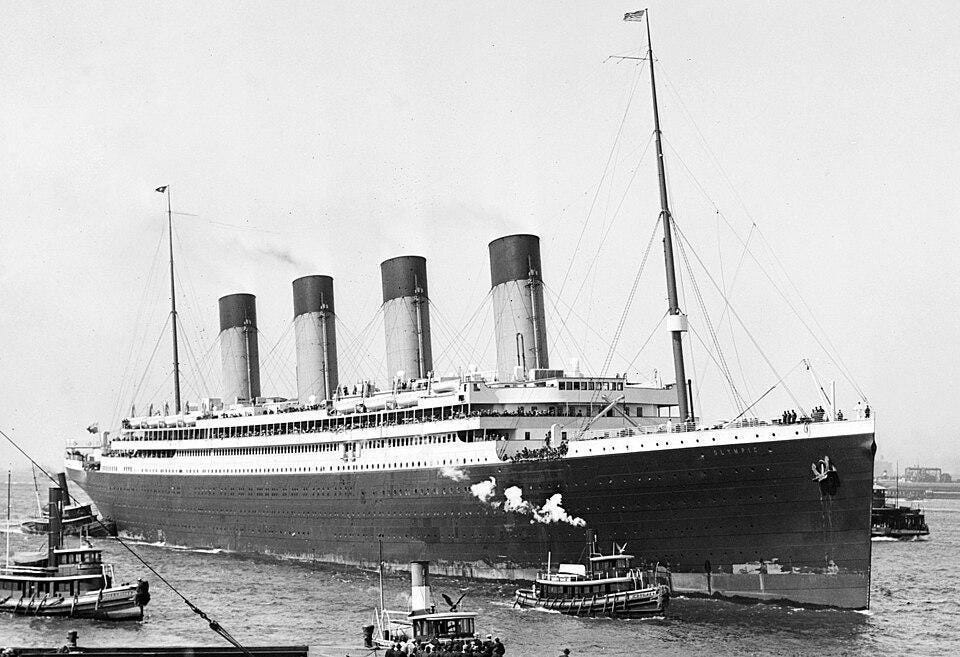
RMS Olympic/Titanic (1911–12) — four funnels (fourth a dummy), the iconic Edwardian liner. RIP Jack Dawson. That door had space for two. Source: Wikipedia
3. Centreline gun turrets: enclosed rotating turrets with protruding gun barrels, arranged along the middle of the ship. Before 1906, turrets were scattered around the deck in various sizes. After 1906, they lined up along the centre in matched sets, giving the classic battleship silhouette of two turrets forward, one or two aft.
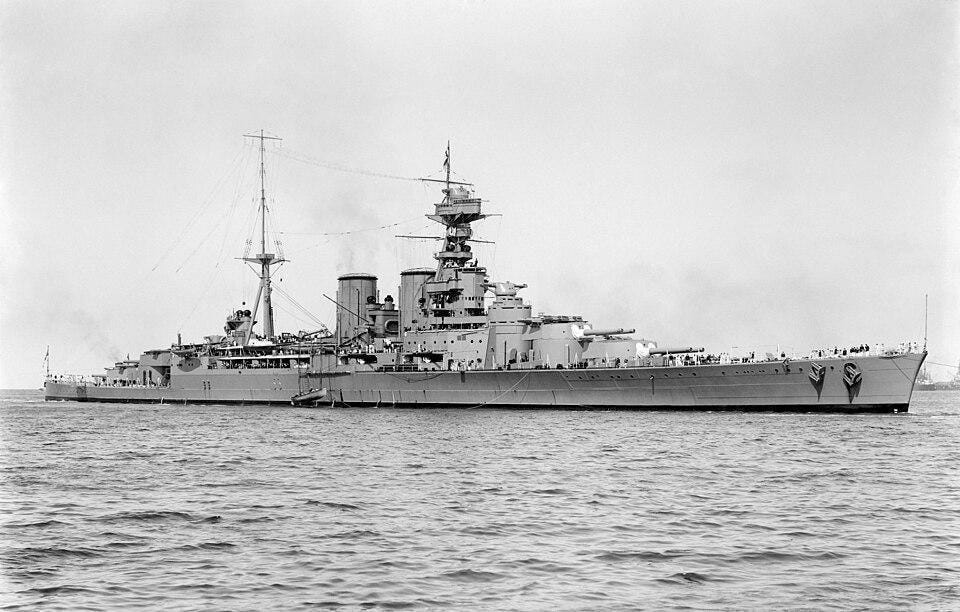
HMS Hood (1920), the world’s largest warship for 20 years. Four twin gun turrets, two funnels. Also the inspiration for this article on laser battleships. Source: Wikipedia
4. Dazzle camouflage: Bold geometric patterns of contrasting colours painted on the hull — not to hide the ship, but to confuse enemy submarine commanders about its heading, speed, and size.
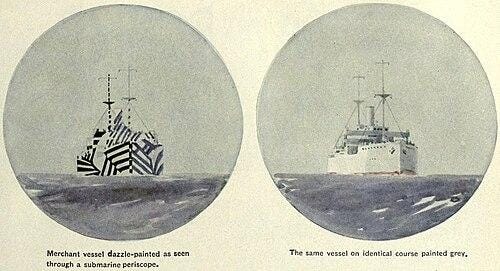
Dazzle camouflage comparison: a merchant vessel in dazzle paint (left) and the same vessel painted grey (right) as seen through a submarine periscope

Dazzle camouflage is still in rare use today.
5. Radar antennas (late era).: By the 1940s, rectangular “bedspring” radar arrays mounted on masts became a clear identifier for late-era warships.
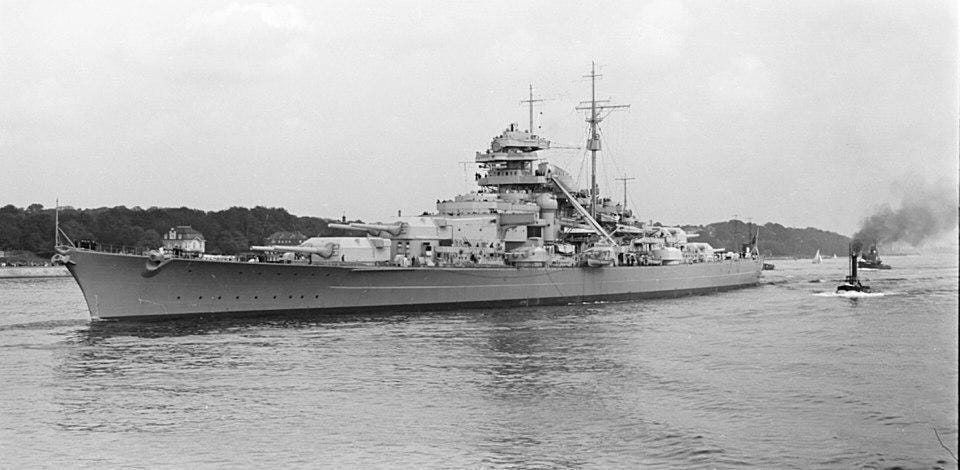
Bismarck (1940) — radar and fire-control directors visible on the foremast superstructure.
Source: Wikipedia
Why ships looked this way
HMS Dreadnought (1906) obsoleted contemporary designs when launched. She mounted ten identical 12-inch guns instead of the usual mix of different calibres. Uniform guns meant every splash was from the same gun type, so a crew could systematically walk their fire onto a target at distance. With mixed caliber guns it wasn’t clear which splash corresponded to which gun, making it hard to calibrate fire. Every navy scrambled to build copies. The switch from coal to oil fuel also eliminated massive coal storage and reduced crew needs. The Washington Naval Treaty (1922) limited battleship size and gun diameter, forcing clever design compromises. By the end of WWII, aircraft carriers had replaced battleships as the decisive weapon.
Age 7: The Modern Era (post-WWII to present)
Key features
1. Angular, flat-panelled hull: Surfaces slope inward with flat panels and almost no external fittings. This shape deflects radar signals away from the sender — the Swedish Visby-class corvette is the extreme, appearing almost featureless. Think ships designed by the sort of people that build shit in minecraft.
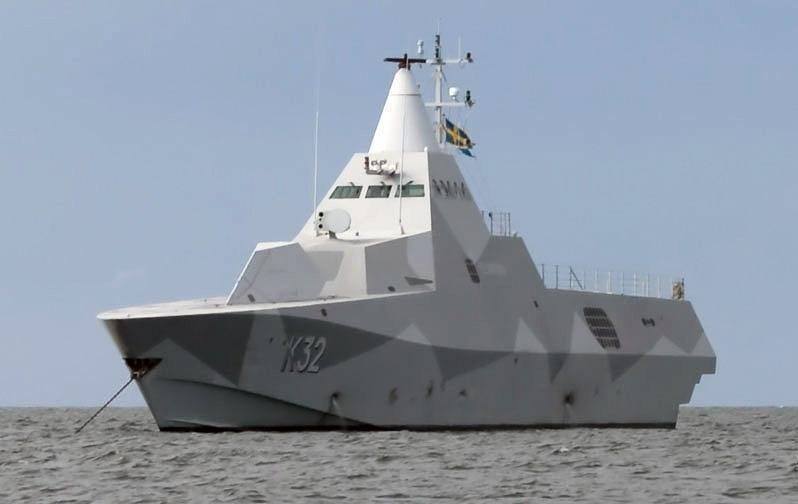
HSwMS Visby, the world’s most radical stealth warship. Carbon-fibre hull, all weapons concealed. Source: Wikipedia
2. No / few visible weapons: Large gun turrets are gone. Missiles launch from rectangular hatches flush with the deck. A single small gun sits at the front but is dwarfed by the ship. Modern warships look almost unarmed (spoiler alert: they are not)
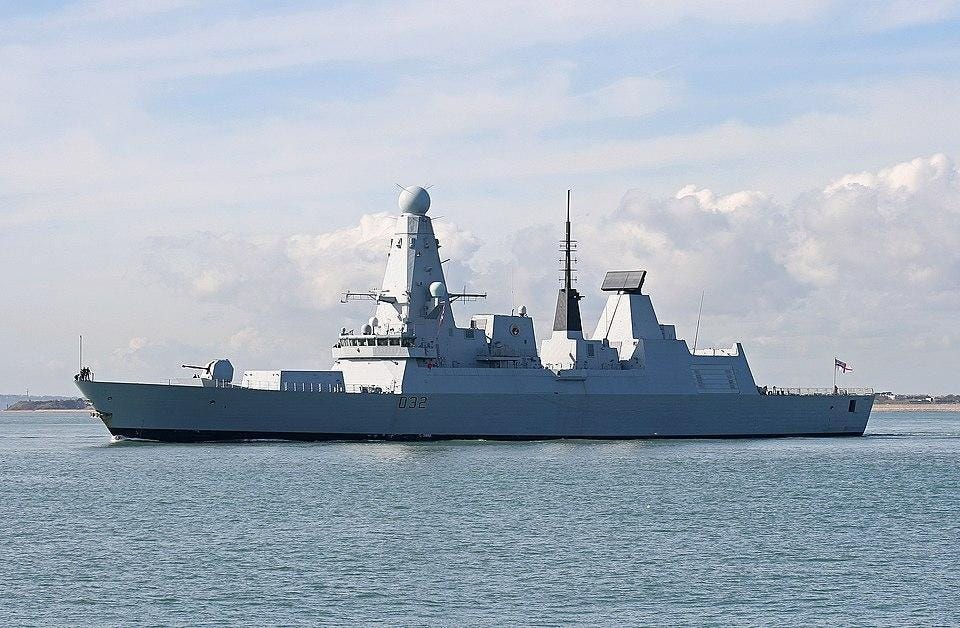
HMS Daring — Type 45 destroyer. Spherical radar dome, angular hull, hidden weapons.
Source: Wikipedia
3. Helicopter deck at the back: nearly every modern European warship carries a helicopter in a hangar at the stern with a flat landing deck, giving the rear third a boxy profile.
![r/WarshipPorn - A Sea King helicopter over the flight deck of Royal Canadian Navy destroyer HMCS Iroquois(DDG 280), Gulf of St Lawrence. 1972 [4023x3007]](https://substackcdn.com/image/fetch/$s_!NhNi!,f_auto,q_auto:good,fl_progressive:steep/https%3A%2F%2Fsubstack-post-media.s3.amazonaws.com%2Fpublic%2Fimages%2F7b588c94-bce1-41f0-90cd-d08e5b620def_640x478.jpeg "r/WarshipPorn - A Sea King helicopter over the flight deck of Royal Canadian Navy destroyer HMCS Iroquois(DDG 280), Gulf of St Lawrence. 1972 [4023x3007]")
A Sea King helicopter over the flight deck of Royal Canadian Navy destroyer HMCS Iroquois(DDG 280), Gulf of St Lawrence. 1972. Source: Reddit
4. Clean-topped profile: Instead of the forests of distinct antennas on WWII ships, modern vessels have a single enclosed mast housing all sensors behind radar-transparent panels.
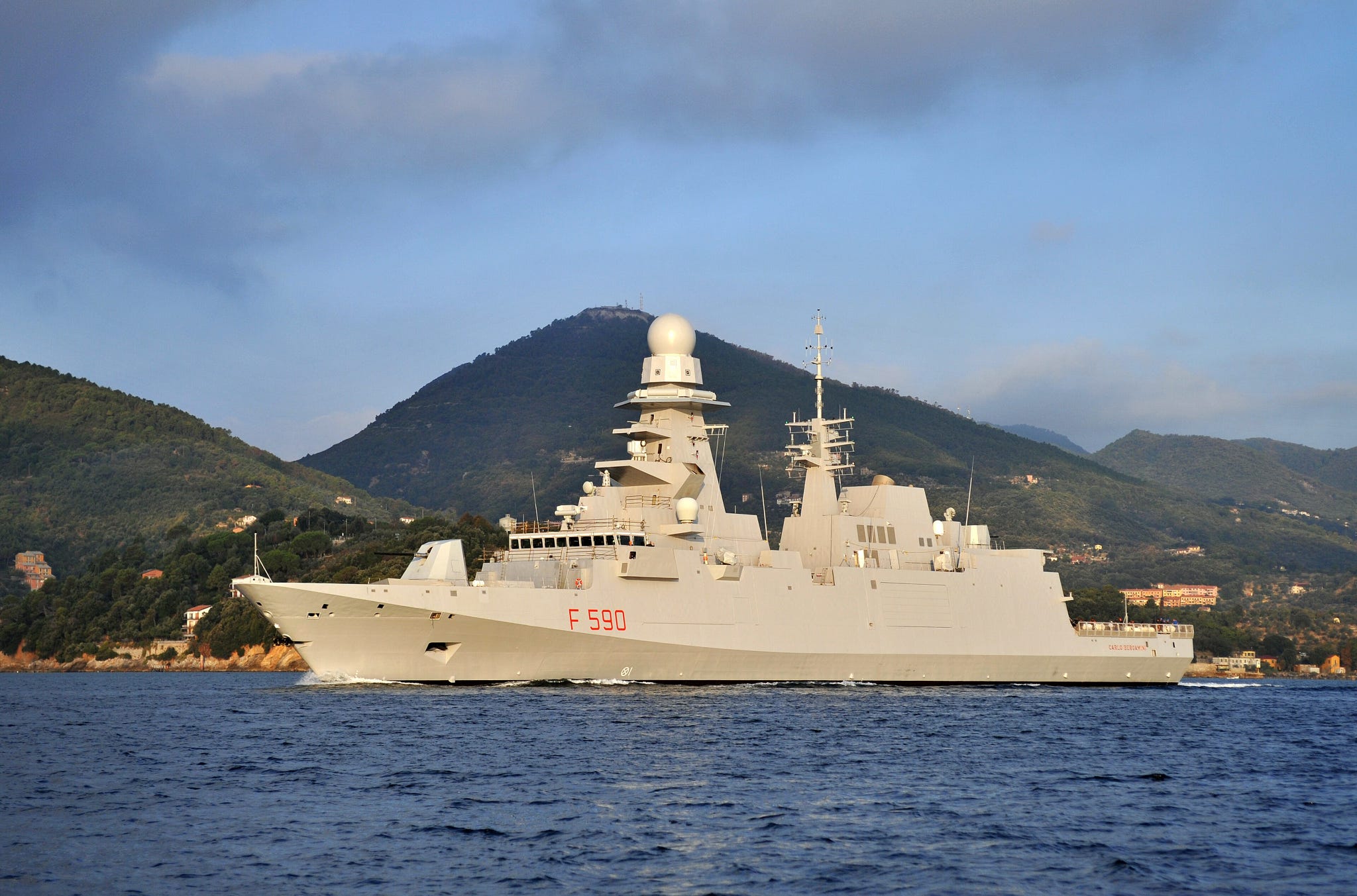
Italian FREMM frigate Carlo Bergamini (F590). Joint French / Italian design. Source: Wikipedia
5. Container ships are walls of boxes: a vast flat hull stacked with uniform coloured boxes, with a tiny bridge structure pushed to the very back. The Emma Maersk carries 157,000 tonnes with a crew of just 13. It can be argued that containerisation was one of the most important technological innovations of all time. Less sexy than nukes and the internet and steam trains, but changed the global economy more than almost anything else.
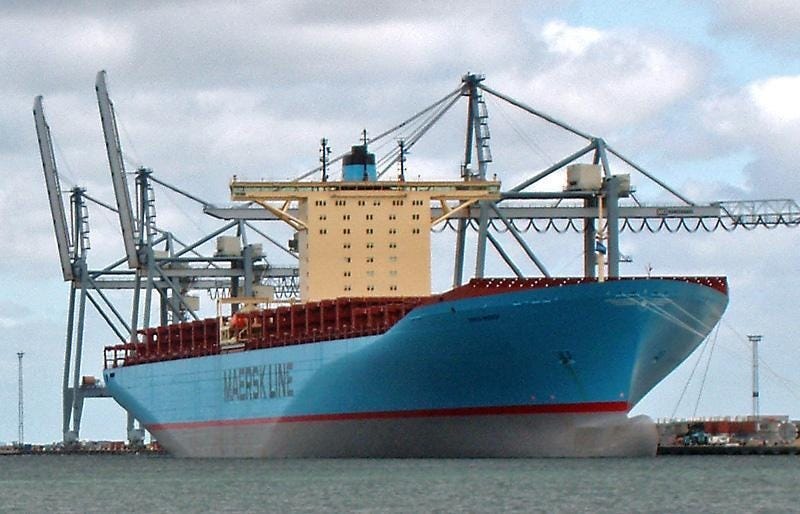
Emma Maersk (2006): 397 metres, 157,000 tonnes, crew of 13. It is about 5x longer and 5x wider than the cutty sark. And weighs about 150x more. Chonky. Source: Wikipedia
Concluding Thoughts
The theme that emerges here is three fold. Ships are identifiable based on how they move, based on what they are made from, and based on how they fight.
In terms of movement, European ship building spent centuries adding more and more canvas and rigging, looking to squeeze every drop of power from the skies. Then within a few generations sail was gone, with steam and turbines obsoleting it completely.
In terms of construction, look at the material and its joins. Early wooden ships have overlapping planks, before later ships acquire smooth edge-to-edge craftsmanship. A similar trend is repeated with metal, with the earliest ironclad ships showing riveting, and later ships showing nothing but smooth welded steel.
Finally, in terms of fighting, early ships were raiding craft or built for boarding, mirroring the defensive style you might see on land, with raised fortified areas to shoot arrows down or from which to disembark boarders. As guns come to the fore, ships acquire more and more gun ports, and lengthen to provide more space for broadsides. During the world wars, ships acquired truly terrifying guns firing thousand kilo shells to the horizons. By the modern era, over the horizon missiles have obsoleted guns almost completely.
And that is all you need to know for the quick and dirty of placing European ships in history or fantasy into their proper context! I hope you enjoyed it. And if you were one of the lucky ten thousand people today encountering something new in the form of ship identification, I hope you feel suitably educated.